The Goju-Ryu Lineage Preserved at Sakura Karate Dojo
At Sakura Karate Dojo, we practice Goju-Ryu, one of the major styles of karate originating in Okinawa. Goju-Ryu is widely recognized as one of Okinawa’s three major karate styles, alongside Uechi-Ryu and Shorin-Ryu, and is also considered one of the four major styles of karate in mainland Japan, together with Shotokan, Shito-Ryu, and Wado-Ryu.
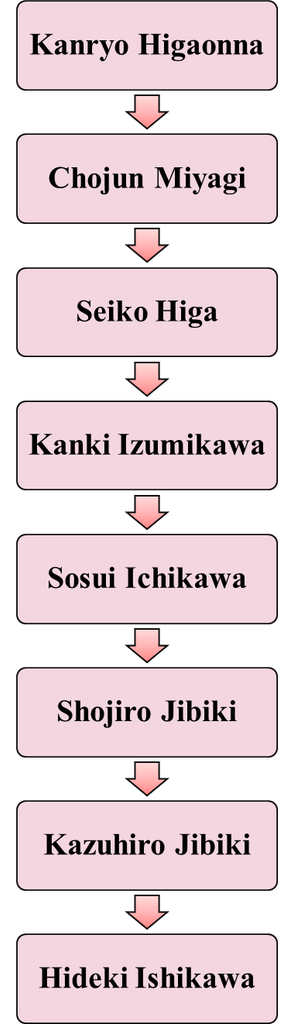
Goju-Ryu karate was founded by Chojun Miyagi Sensei, a native of Naha, Okinawa. Miyagi Sensei trained extensively under Kanryo Higaonna Sensei, the legendary master of Naha-te, one of Okinawa’s traditional martial arts. Building on the teachings of Naha-te while incorporating elements of Chinese martial arts from Fujian Province, Miyagi Sensei developed and refined his own martial arts system. In 1929, he formally adopted the name Goju-Ryu, representing the harmony of go (“hard” or powerful techniques) and ju (“soft” or flexible techniques).
Today, Goju-Ryu has developed into several lineages, and Sakura Karate Dojo follows the lineage of Seiko Higa Sensei. Higa Sensei trained under Kanryo Higaonna Sensei and, following Higaonna Sensei’s passing, also studied under Chojun Miyagi Sensei. Higa Sensei’s lineage of Goju-Ryu is regarded as preserving some of the oldest forms of kata with great fidelity. While Miyagi Sensei’s lineage increasingly moved toward a more physical-education-oriented approach after World War II, emphasizing health and physical fitness, Higa Sensei continued to teach Goju-Ryu consistently as a martial art, including bunkai—the practical applications of kata techniques. This commitment to preserving and transmitting the essence of traditional martial arts is one of the defining characteristics of Higa Sensei’s Goju-Ryu.
At Sakura Karate Dojo, we preserve and pass on not only the kata of Goju-Ryu, but also kata from the older Okinawan martial traditions of Naha-te and Shuri-te, which predate the establishment of today’s major karate styles. These kata are rarely seen in modern Goju-Ryu dojos and represent a unique and valuable part of the martial heritage preserved through our training.